Villages in Cyprus

For wine, base yourself around Omodos, Vasa and Koilani in the Limassol hills. For heritage and painted churches, try Kakopetria, Pedoulas and Kalopanagiotis in the Troodos. For crafts, go to Lefkara in the Larnaca hills. Choose one area per day, because the villages are small and the roads are slow.

Best for
Travellers who want to leave the coast and choose a village base or a day of village stops.
How much time
A day for one area; a night in a village makes it easier.
In this guide
  1. Wine villages in the Limassol hills
  2. Troodos mountain villages
  3. Hill villages near Lefkara
  4. A Paphos-hills village
  5. How to choose

Cyprus villages are the island's quieter side: stone houses, small museums, wineries and churches, mostly in the hills behind the coast. Visit Cyprus publishes a page for each, and this guide pulls fifteen of them into one comparison, grouped by area, so you can pick a day. Facts here come from those official pages, and we do not print distances or opening hours because they change. For the wider picture, see the Troodos overview and the Cyprus travel guide.

Wine villages in the Limassol hills

Omodos

A wine-producing village in the Krassohoria area. Visit Cyprus lists its cobbled square, old stone houses, local wineries, a medieval wine press and the monastery of Timios Stavros, plus a centre for narrow-knit lacing, a museum of the National Liberation Struggle and an icon museum.

Worth it?The most complete wine-village stop: you can combine a winery, a monastery and lunch on foot. Its religious fair on 14 September lasts three days and is one of the island's biggest, so expect crowds then.

Skip ifYou want a village with no visitors.

Open in MapsOfficial information

Vasa Koilaniou

A wine-producing village noted for its limestone architecture, paved streets, old wine presses and Zivania distilleries. Visit Cyprus lists a Museum of Zivania, a Museum of Education, an Ecclesiastical Museum, a winery and a small nature trail.

Worth it?A good second village on a wine day, with more museums than most villages of its size.

Open in MapsOfficial information

Koilani

One of the island's main grape-growing villages, known for its wines, aromatic arkatena rusks and sweet pastries. Visit Cyprus notes carved limestone houses and old earthenware jars displayed in yards.

Worth it?Worth a stop for the village character and local products rather than for set sights.

Open in MapsOfficial information

Lania

A small, traditional grape-growing village with an old wine press, a Commandaria Storage Museum and an old olive press. Every May its women open their courtyards to visitors for the Lanes and Courtyards of Lania event.

Worth it?A quiet wine village; time a visit for May if you want the courtyard event, and check dates first.

Open in MapsOfficial information
Troodos mountain villages

Platres

A village laid out like a theatre on the Troodos slopes. Visit Cyprus lists nature trails, the Caledonia waterfall (one of the highest in Cyprus), a winery in Kato Platres, a chocolate workshop, a rope park and a cultural centre.

Worth it?A practical mountain base with trails nearby. Check the official difficulty rating before you walk to the waterfall: see Cyprus nature trails.

Open in MapsOfficial information

Foini

Considered one of the island's most naturally beautiful areas, with a waterfall and pine forest. It is known for pottery, traditional furniture and loukoumi, and has workshops, a folk-art museum and the Hantara waterfalls nearby.

Worth it?Good for crafts and a short forest outing; the Trooditissa to Foini trail is rated 1 by Visit Cyprus.

Open in MapsOfficial information

Agros

A village in a theatre-shaped setting, famous for roses and for cured meats, marmalades and sweets. Visit Cyprus says visitors can see rose-oil distillation, sweet-making and meat processing at local workshops.

Worth it?Best for food shopping and workshops; go in the growing season if you want the rose connection.

Open in MapsOfficial information

Kakopetria

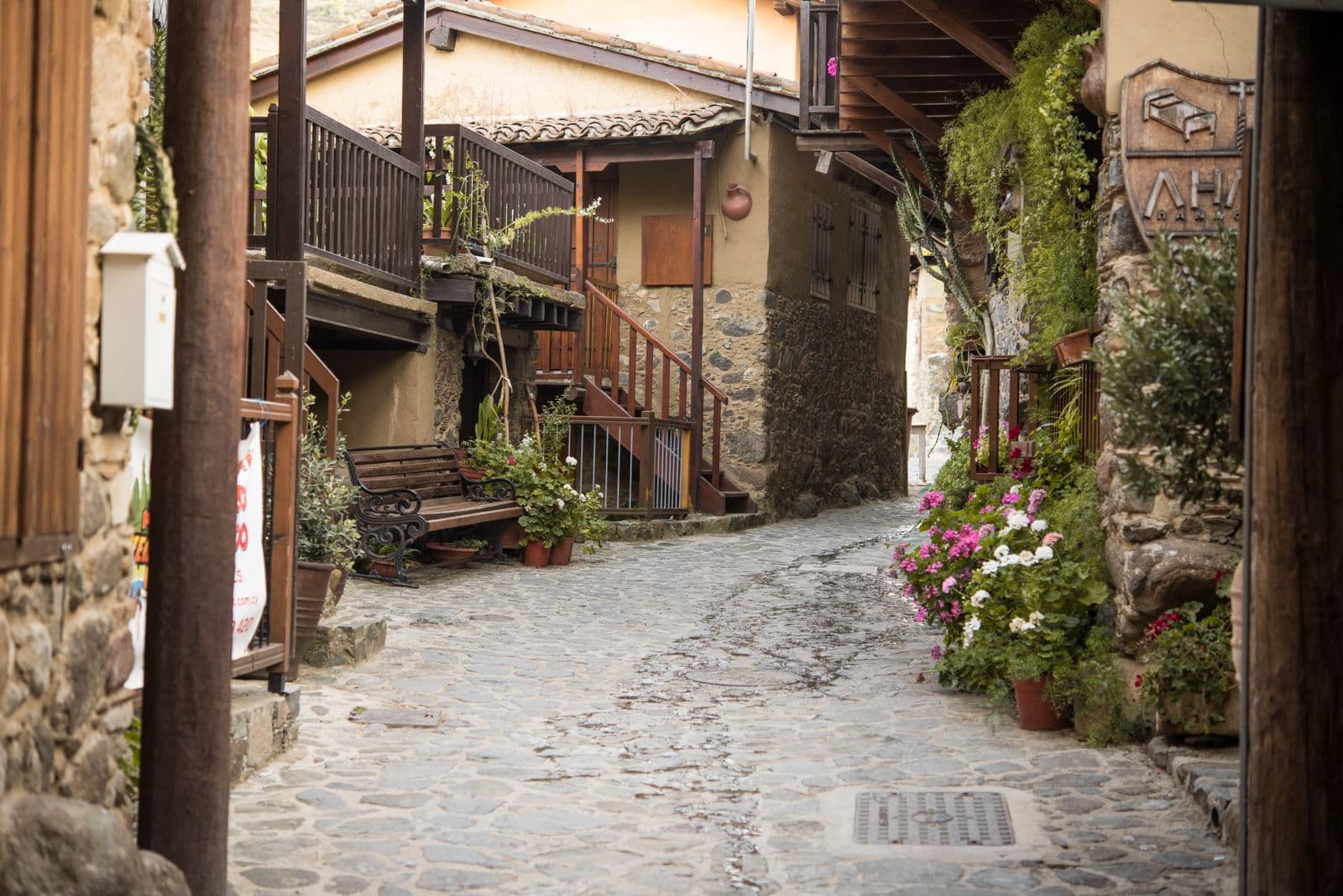
A summer resort among pine forest whose restored old quarter, with stone-paved alleys and wooden-balconied houses, is a protected heritage site. Visit Cyprus lists a church in the old centre, a watermill, an olive mill museum and the painted church of Agios Nikolaos tis Stegis nearby.

Worth it?A good overnight base for painted churches, with a walkable old quarter.

Open in MapsOfficial information

Pedoulas

A village among orchards known for cherries. Its church of Archangelos Michael (1474) is one of the Troodos painted churches on the UNESCO list, and there is a Byzantine museum and a folk art museum.

Worth it?Combine the church with a short village stroll.

Open in MapsOfficial information

Kalopanagiotis

A village in the Marathasa valley with sulphur springs, traditional architecture and valley views. Visit Cyprus lists the UNESCO-listed Agios Ioannis Lampadistis monastery, a Venetian bridge and the Kykko watermill.

Worth it?One of the best small stops for combining heritage and a quiet setting.

Open in MapsOfficial information

Fikardou

An almost deserted village in the Pitsilia region, declared an Ancient Monument in 1978 and awarded a Europa Nostra award in 1987 for restoring its 18th-century houses. Two houses are now museums.

Worth it?A short stop for folk architecture; it is a village to look at rather than stay in.

Skip ifYou want shops, cafés and activity.

Open in MapsOfficial information

Hill villages near Lefkara

Lefkara

A mountain village split into Pano and Kato Lefkara, world-renowned according to Visit Cyprus for lace embroidery and filigree silver. It has a handicraft centre, a museum, narrow streets and an annual festival each August.

Worth it?The classic craft village; ask where an item was made if authenticity matters to you.

Open in MapsOfficial information

Kato Drys

A tiny mountain village near Lefkara, referred to by Visit Cyprus as the birthplace of Agios Neofytos the Recluse, where Lefkara lace is also practised. It has a rural museum and a bee and embroidery museum.

Worth it?A quiet add-on to a Lefkara visit.

Open in MapsOfficial information

Tochni

One of the island's oldest villages, with houses built of locally quarried Tochni stone, a small Byzantine museum and a Latin church. Visit Cyprus says bike centres and horse-riding are available.

Worth it?Suits cyclists and travellers who like a slower village.

Open in MapsOfficial information

A Paphos-hills village

Panagia

A village largely within Paphos Forest, close to the Chrysorrogiatissa monastery. Visit Cyprus says it is the birthplace of Archbishop Makarios III, with two museums dedicated to him, and lists local wineries and the Vouni Panagias nature trail.

Worth it?The natural stop for a Paphos-hills wine day. See wineries in Cyprus.

Open in MapsOfficial information

How to choose

You want…Look at
A wine dayOmodos, Vasa Koilaniou, Koilani and Lania, then see Cyprus wine
Painted churchesKakopetria, Pedoulas and Kalopanagiotis, then see ancient sites in Cyprus
CraftsLefkara and Kato Drys
WalkingPlatres and Foini, then see Cyprus nature trails
Cooler air in summerThe Troodos villages, where Visit Cyprus's figures put temperatures below the plain; see Cyprus in summer
  • One area per day: the villages are small, and Visit Cyprus advises extra care on minor and forest roads, so allow extra time between villages. See driving in Cyprus.
  • Go without a car: Visit Cyprus says rural buses reach almost every village but typically run only two or three times a day. See Cyprus without a car.
  • Check dates for fairs: several villages hold annual fairs and festivals, listed in Cyprus festivals and events.

To compare bases, see where to stay in Cyprus.

Check before you go

Hours, prices and schedules change. Confirm them at the source: