Cyprus Travel Guide
Cyprus works best with a hire car, one or two bases rather than five, and at least a day in the Troodos mountains. Choose Paphos for history with quiet coast, Limassol for a lively central city, Larnaca for simplicity, and Ayia Napa or Protaras if sandy beaches are the point. Spring and autumn are the easiest seasons.
- Best for
- First-time planners deciding when to go, where to base and whether they need a car.
- How much time
- One week covers the main regions without rushing; ten days lets you add the mountains and a slower coast.
In this guide
When to visit Cyprus
Cyprus has long hot, dry summers, mild winters and short, green springs. The honest summary: April–June and September–October give you warm sea or warm air without the heat that makes midday sightseeing a chore. July and August are for the beach and the pool; plan archaeological sites for early morning.
Winter is quieter, greener and cooler. You can still do coastal walks, villages and ancient sites, and the Troodos can see snow. See Cyprus in winter for what stays open and who it suits. For live forecasts and climate data, use the Department of Meteorology rather than any blog's averages, including ours.
Where to stay: choosing your base
Your base matters more than your hotel. Cyprus is small, but mountain roads and summer traffic make a badly placed base cost you hours. Pick the base that matches your priority, then do the rest as day trips. For a fuller decision guide by trip length, traveller type and season, see where to stay in Cyprus.
| Base | Best for | Car needed? | Skip if |
|---|---|---|---|
| Paphos | Archaeology, harbour evenings, access to the Akamas and west coast | Strongly advised beyond Kato Paphos | You want a big-city nightlife scene |
| Limassol | Restaurants, seafront, central location for Kourion and wine villages | Helpful, not essential in town | You want quiet, wild coastline on your doorstep |
| Larnaca | Simple logistics, first or last night, salt lake and old town | Optional in town | You expect dramatic scenery |
| Ayia Napa | Sandy beaches, boat trips, nightlife | Optional if you stay near the centre | You dislike busy resort streets |
| Protaras | Calmer family beach holidays | Helpful for exploring | You want historic character |
| Polis / Latchi | Akamas walks, quiet northwest coast | Yes | You want lots of evening options |
| Troodos villages | Cool air, painted churches, hiking, wine villages | Yes | Your priority is the beach |
| Nicosia | The capital's museums and old city | Not in the old city | You want a beach base |
Not sure? Best places to visit in Cyprus compares the main destinations, and our destination overviews say who each suits and who should pick elsewhere.
Getting there: airports
The Republic of Cyprus has two international airports: Larnaca (LCA) on the southeast coast, which handles the most routes, and Paphos (PFO) in the west. Choose the airport nearest your first base, and consider an open-jaw ticket (arrive in one, leave from the other) if you plan a one-way route such as our 7-day itinerary. Airports in the north of the island are outside the Republic's control and are not covered in these guides.
Getting around
Cyprus has no trains. Visit Cyprus lists four kinds of bus: airport buses linking all the towns to Larnaca and Paphos airports, interurban buses linking all major towns daily, urban buses, and rural buses that reach almost every village but, it says, typically run only two or three times a day. That network suits getting between towns, not sightseeing: most villages, the Akamas and many archaeological sites are impractical without a car. Check current routes and timetables at Cyprus Public Transport before relying on a bus. If you do not want to drive, read Cyprus without a car first.
- Hire car: the best way to see the island, and essential for the Troodos, the Akamas and most villages. Visit Cyprus says major self-drive firms have offices in every town and at both airports.
- Taxi / ride-hailing: urban taxis run in every town and, according to Visit Cyprus, must use the meter; rural taxis have no meter and charge by tariff, so agree the arrangement before any remote trip. Costs add up on longer routes.
- Tours: a sensible option for a single day (for example the Akamas or the mountains) if you do not want to drive.
- Without a car: base in Paphos, Limassol, Larnaca or Ayia Napa, which can be walked, and book one or two guided days.
Driving in Cyprus
- Traffic drives on the left, as in the UK, and roundabouts are common.
- Motorways link the main cities along the south coast and to Nicosia; mountain and village roads are slower and winding. Visit Cyprus says minor and forest roads are largely unsurfaced but in good to fair condition, and asks for extra care on them in wet weather. Do not trust a straight-line map for timing: use live directions.
- Check your licence is valid for hire with the rental company before you travel, and read the insurance terms carefully.
- Fuel up before heading into the mountains or the Akamas, where stations are fewer.
- Crossing to the north in a hire car depends on your rental agreement and insurance. Many contracts restrict it. Ask before you book, not at the checkpoint.
Money, language and the basics
- Currency: the euro. Cards are widely accepted in towns; carry some cash for villages, small cafés and parking.
- Language: Greek and Turkish are official. English is widely spoken in tourist areas. A few Greek words are appreciated: kalimera (good morning), efharisto (thank you), parakalo (please / you're welcome).
- Electricity: UK-style three-pin sockets (type G); bring an adapter if your plugs differ.
- Emergency number: 112.
- Entry requirements: these depend on your nationality and change. Check your government's travel advice and the official visit portal before booking.
The regions in one minute
- West (Paphos, Polis, Akamas): UNESCO-listed mosaics and tombs, wild peninsula, quieter beaches.
- South (Limassol, Kourion): the island's most urban coast, ancient Kourion, and the wine villages behind the city.
- Southeast (Larnaca): the main airport, a walkable seafront, salt lake, and easy reach of Lefkara and Choirokoitia.
- East (Ayia Napa, Protaras): the island's best-known sandy resort beaches.
- Centre (Troodos): forested mountains, painted churches, hiking and the wine-growing villages.
- Inland (Nicosia): the divided capital; a city day, not a beach base.
Beaches in one paragraph
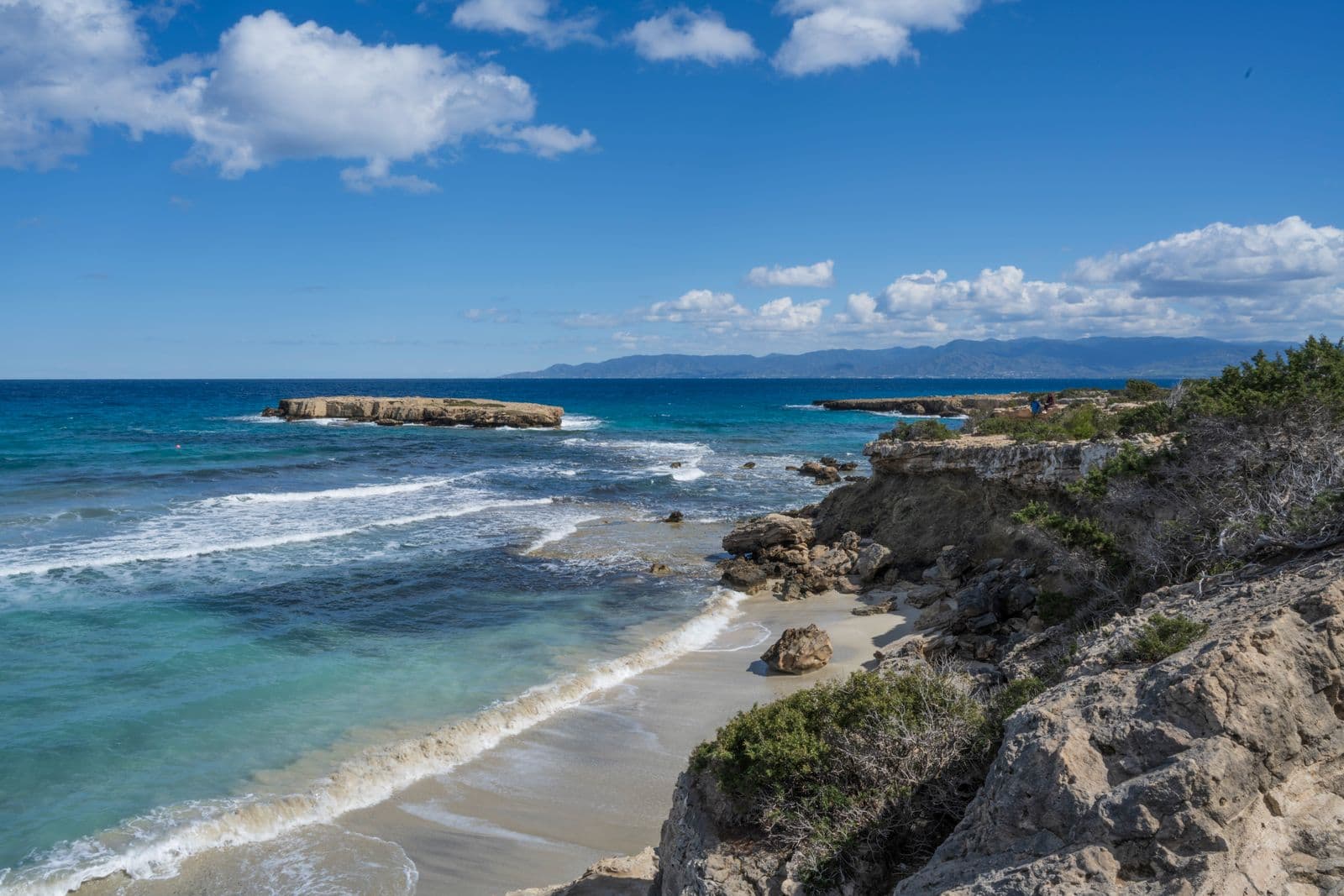
Sandy, family-friendly beaches are concentrated in the east (Ayia Napa and Protaras) and around Larnaca. The west has pebble and mixed beaches with a wilder character, plus a few sandy bays. For a full comparison, see Best beaches in Cyprus.
Food and culture
Order meze if you are in a group: it is the best way to taste the island in one meal. Halloumi, grilled meats, slow-cooked village dishes and seasonal vegetables form the core of the table. Our Cypriot food guide explains what to order. When visiting monasteries and churches, cover shoulders and knees and follow any signs about photography.
Safety and common-sense risks
Cyprus is generally considered a safe destination for visitors. The practical risks are the ordinary ones: heat and sun in summer, fast and sometimes careless driving, strong currents on exposed beaches, and wildfire risk in dry months. Take heat seriously when hiking, carry water, and follow local authority warnings. For current official advice, see the GOV.UK foreign travel advice or your own government's equivalent.
Itineraries and next steps
- Cyprus 7-day itinerary: a west-to-south route with sensible bases.
- Cyprus road trip: a longer island loop with stops and where to sleep.
- Best things to do in Cyprus: the ranked list of experiences.
Frequently asked questions
Do I need a car in Cyprus?
For the mountains, the Akamas and most villages, yes. If you are staying in a walkable town and sticking to the coast, you can manage with taxis and one or two organised tours.
How many days do I need?
A week lets you see the west, the mountains and the south coast at a sensible pace. Add days rather than adding bases.
Which airport should I fly into?
Larnaca has the most routes and is central to the island's southeast; Paphos is closer if you are staying in the west. If your route is one-way, fly into one and out of the other.
Check before you go
Hours, prices and schedules change. Confirm them at the source:
- Visit Cyprus (Deputy Ministry of Tourism)
- Cyprus Department of Meteorology
- Cyprus Public Transport: intercity and local bus information
- GOV.UK foreign travel advice: Cyprus
- Visit Cyprus: transportation: buses, taxis, car hire, driving
- Visit Cyprus: health and safety: emergency number 112